Guide · Microsoft Azure and Microsoft 365
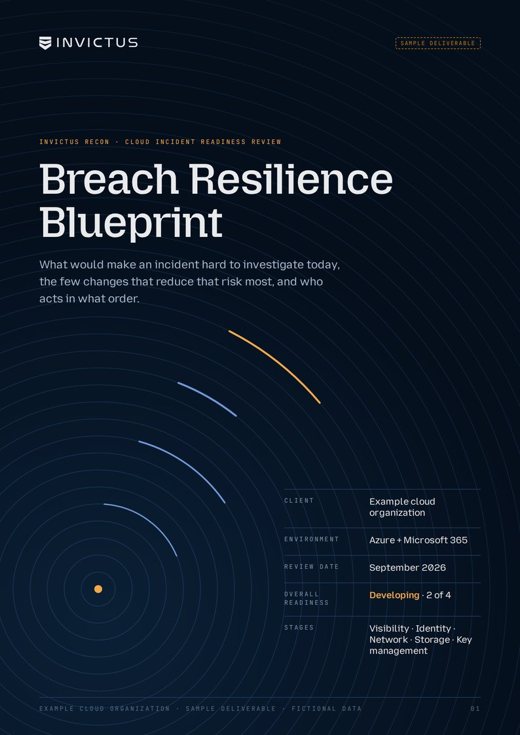
Breach Resilience Blueprint
Fifteen controls and logging sources in five steps: the ones that matter most when an incident has to be investigated. Drawn from the cloud incidents we respond to, and balanced against cost, reliability, operations and performance.
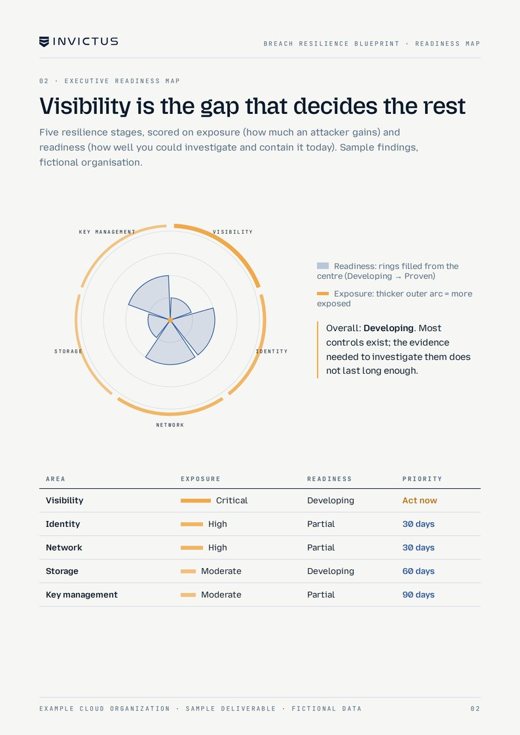
- 01VisibilityYou cannot respond to what you cannot see.
- 02IdentityIdentity is the perimeter.
- 03NetworkOpen management ports remain a primary way in for ransomware and data theft.
- 04StorageOnce inside, attackers use storage to stage, steal and destroy data.
- 05Key VaultsExpiration and rotation are kill switches for stolen credentials.
Visibility
You cannot respond to what you cannot see. Centralized, tamper-resistant logs, kept long enough to prove what happened for legal, insurance and recovery needs.
- Impact
- High
- Likelihood
- Almost certain
- Effort
- Low, mostly one-time configuration
| Pillar | Rating | What it means |
|---|---|---|
| Security | ★★★ | Essential for detection, root-cause analysis and threat hunting. |
| Cost | ★★★ | Long-term log storage is the main cost driver. |
| Reliability | ★★★ | Audit trails cannot be lost or tampered with by an adversary. |
| Operational | ★★★ | One queryable store simplifies SOC workflows. |
| Performance | ★★★ | No impact on application speed. |
The controls
- Tier 1 must-have sources: Entra ID sign-in, Entra ID audit, Azure Activity, Unified Audit Log
- Tier 2 should-have: Microsoft Graph activity
- Tier 3 nice-to-have: storage audit, network flow, other resources
- Retention: 180 days standard, 365 days best practice, 2 to 7 years where regulation requires
- One central, searchable store, protected against deletion
Identity
Identity is the perimeter. Most cloud breaches start with stolen sessions or consent phishing, not passwords.
- Impact
- High
- Likelihood
- Highly likely
- Effort
- Medium to high, needs user communication and rollout
| Pillar | Rating | What it means |
|---|---|---|
| Security | ★★★ | Stops modern bypass techniques such as adversary-in-the-middle. |
| Cost | ★★★ | Uses native Entra ID features. |
| Reliability | ★★★ | Prevents credential-stuffing lockouts. |
| Operational | ★★★ | High initial user impact; changes daily sign-in. |
| Performance | ★★★ | A minor delay at sign-in only. |
The controls
- Few Global Administrators, with just-in-time privileged access
- Phishing-resistant MFA for every admin role
- No user app registration or user consent; an admin consent workflow instead
- Block device code flow where it is not needed
- Block or step up high-risk sign-ins
Network
Open management ports remain a primary way in for ransomware and data theft.
- Impact
- High
- Likelihood
- Likely
- Effort
- Medium, needs gateway services
| Pillar | Rating | What it means |
|---|---|---|
| Security | ★★★ | Removes most automated entry attempts. |
| Cost | ★★★ | Gateway costs are low next to a breach. |
| Reliability | ★★★ | Prevents brute-force resource exhaustion. |
| Operational | ★★★ | Access goes through a gateway, not direct. |
| Performance | ★★★ | Minor inspection latency. |
The controls
- No RDP or SSH from the internet: use a bastion or just-in-time access
- Restrict inbound UDP
- Web traffic only through an application gateway with a WAF
Storage
Once inside, attackers use storage to stage, steal and destroy data.
- Impact
- High
- Likelihood
- Realistic probability
- Effort
- Medium, check app dependencies first
| Pillar | Rating | What it means |
|---|---|---|
| Security | ★★★ | Prevents accidental exposure and tracks exfiltration. |
| Cost | ★★★ | Private endpoints and logging add minor cost. |
| Reliability | ★★★ | Soft delete protects against scorched-earth deletion. |
| Operational | ★★★ | More DNS and network management. |
| Performance | ★★★ | Private traffic can reduce latency. |
The controls
- No anonymous blob access
- Network access limited to private endpoints, trusted networks or approved ranges
- Soft delete for blobs, containers and file shares on critical accounts
Key Vaults
Expiration and rotation are kill switches for stolen credentials.
- Impact
- High
- Likelihood
- Realistic probability
- Effort
- Low to medium, mostly policy settings
| Pillar | Rating | What it means |
|---|---|---|
| Security | ★★★ | Neutralizes stolen credentials and stops persistence. |
| Cost | ★★★ | Native features, negligible cost. |
| Reliability | ★★★ | A safety net against malicious deletion. |
| Operational | ★★★ | Coordinate rotation with developers. |
| Performance | ★★★ | No impact on retrieval. |
The controls
- Expiration dates on every key and secret
- Automatic key rotation
- Role-based access control instead of legacy access policies
From guide to your environment
The same five steps, scored for you
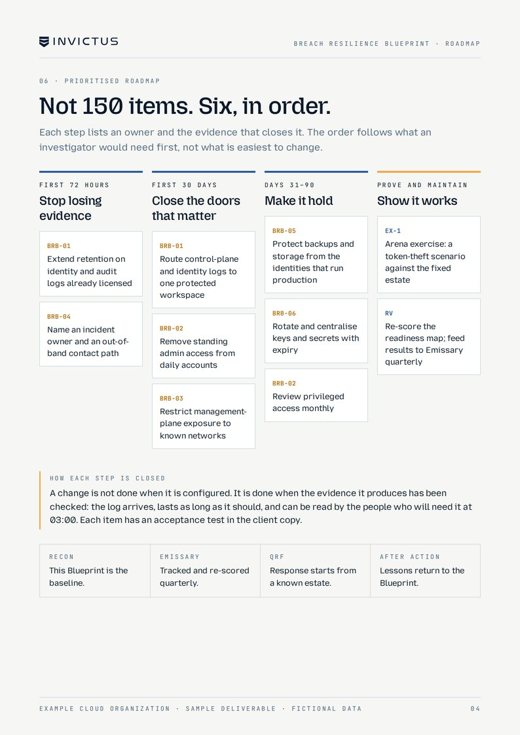
In the Response Readiness Program and Forensic Readiness, the Blueprint becomes your deliverable: a readiness map across the five steps, every gap with an owner, effort and target date, and a roadmap from the first 72 hours to proving it works.

Find out which five steps your cloud would fail.
A short call to agree scope. We work read-only, and you keep a scored roadmap.