On this page
- Summary
- Overview
- TTPs
- Initial Access · T1190 — Exploit Public-Facing Application
- Initial Access · T1195 — Supply Chain Compromise
- Initial Access · T1078.004 — Valid Accounts: Cloud Accounts
- Lateral Movement · T1210 — Exploitation of Remote Services
- Lateral Movement · T1550.002 — Pass the Hash
- Lateral Movement · T1199 — Compromise Application: Multi-Tenant Applications
- Privilege Escalation · T1078.002 — Valid Accounts: Domain Accounts
- Credential Access · T1528 — Steal Application Access Token
- Persistence · T1098.001 — Create or Modify System Process: Service Principal
- Persistence · T1098.004 — Account Manipulation: Additional Cloud Credentials
- Persistence · T1505.003 — Server Software Component: Web Shell
- Defense Evasion · T1036 — Masquerading
- Collection · T1213.002 — Data from Information Repositories: SharePoint
- Collection · T1114.002 — Email Collection: Remote Email Collection
- Collection · T1213.003 — Data from Cloud Storage: OneDrive
- Command and Control · T1071.001 — Application Layer Protocol: Web Protocols
- Incident Response Steps
- 1. Exploit Public-Facing Application
- 2. Supply Chain Compromise
- 3. Server Software Component: Web Shell
- 4. Data Exfiltration from Repositories
- Getting Help
- About Invictus Incident Response
Summary
- Threat Actor: Silk Typhoon (China-nexus) a.k.a., HAFNIUM, timmy
- Motivation: State-affiliated espionage
- Targeting: Azure and M365 enviornments, Government, IT, MSPs, defense, healthcare, and NGOs
- Attack Types: Zero-days, Entra Connect, abuse OAuth/Graph/EWS for email/data theft
- Defenses: Lock Entra Connect, audit OAuth apps, monitor Graph/EWS, enforce MFA, and segment on-prem/cloud.
If you enjoy reading about cloud threat actors, you might also enjoy our training or investigating your own cloud incidents with Cloud Labs.
Overview
Silk Typhoon, also known as HAFNIUM, is assessed to be a Chinese state-affiliated threat actor first identified in early 2021, driven by espionage motives and targeting sectors such as defense, transportation, media, NGOs, and healthcare. The threat actor gained prominence for exploiting four zero-day vulnerabilities in Microsoft Exchange Server (CVE-2021-26855, CVE-2021-26857, CVE-2021-26858, CVE-2021-27065) in March 2021, enabling unauthenticated remote code execution and widespread compromise of on-premises Exchange servers. This campaign allowed Silk Typhoon to deploy web shells for persistent access and data exfiltration, targeting thousands of organizations globally.
In February 2025, the threat actor exploited a zero-day vulnerability (CVE-2025-3928) in Commvault’s Metallic Microsoft 365 backup SaaS platform on Microsoft Azure, using web shells to access client secrets and infiltrate customers’ Microsoft 365 environments, showcasing their focus on cloud-based supply chain attacks. By targeting IT supply chains, Silk Typhoon leverages trusted vendor relationships to compromise downstream cloud environments.
Silk Typhoon demonstrates cloud-fluent tactics by exploiting on-premises footholds to pivot into cloud environments, targeting Microsoft Entra Connect servers to synchronize and escalate privileges between Active Directory and Entra ID for lateral movement. Once in the cloud, the group manipulates service principals and OAuth applications with administrative consents to abuse Microsoft Graph and Exchange Web Services (EWS) APIs for targeted exfiltration of email, OneDrive, and SharePoint data.
TTPs
All of the details below are also available in our GitHub repository, which provides background on each observed technique along with corresponding MITRE ATT&CK mappings, making it easy to map these insights directly to your cloud logs.
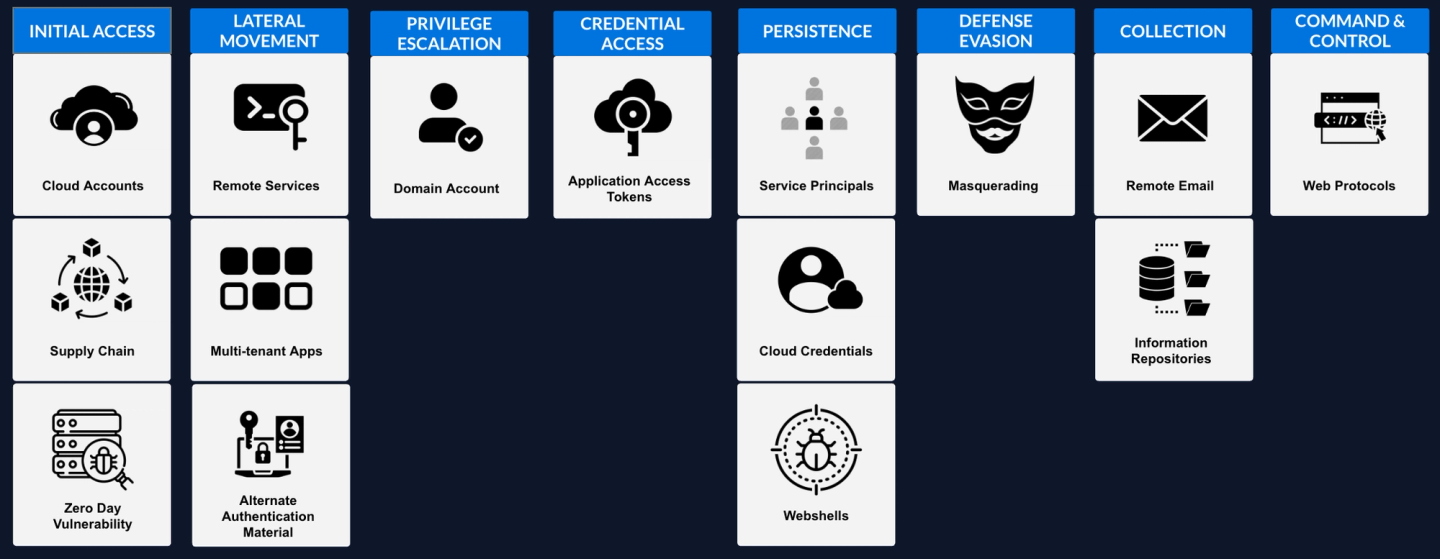
Initial Access · T1190 — Exploit Public-Facing Application
Commvault Campaign: The threat actor exploited CVE-2025-3928, a zero-day vulnerability in Commvault Web Server, to gain unauthorized access to Commvault's Azure environment.
Initial Access · T1195 — Supply Chain Compromise
Commvault Campaign: The threat actor abuses stolen API keys and credentials associated with privileged access management, cloud app providers, and cloud data management companies.
Initial Access · T1078.004 — Valid Accounts: Cloud Accounts
Commvault Campaign: Silk Typhoon leveraged leaked corporate passwords found on public repositories, such as GitHub, to successfully authenticate to corporate SaaS accounts.
Lateral Movement · T1210 — Exploitation of Remote Services
General: The threat actor moves laterally from on-premises to cloud environments by targeting Entra Connect servers to escalate privileges and gain access to both environments.
Lateral Movement · T1550.002 — Pass the Hash
General: The threat actor dumps Active Directory credentials and steals passwords from key vaults to facilitate lateral movement from on-premises to cloud environments.
Lateral Movement · T1199 — Compromise Application: Multi-Tenant Applications
General: The threat actor compromises multi-tenant applications, enabling movement across tenants and access to additional resources for data exfiltration.
Privilege Escalation · T1078.002 — Valid Accounts: Domain Accounts
General: The threat actor escalates privileges by compromising Entra Connect servers, enabling access to both on-premises and cloud environments.
Credential Access · T1528 — Steal Application Access Token
Commvault Article: The threat actor accessed client secrets for Commvault's Metallic M365 backup SaaS solution hosted in Azure, allowing unauthorized access to customers' M365 environments via hijacked service principals.
Persistence · T1098.001 — Create or Modify System Process: Service Principal
General: The threat actor manipulates service principals by adding their own passwords to existing consented applications or creating new Entra ID applications to maintain access and facilitate data theft.
Persistence · T1098.004 — Account Manipulation: Additional Cloud Credentials
Commvault Campaign: The threat actor potentially manipulated or used stolen client secrets to maintain access to M365 environments.
Persistence · T1505.003 — Server Software Component: Web Shell
Commvault Campaign: The threat actor deployed web shells to gain unauthorized access to the cloud-hosted web server.
Defense Evasion · T1036 — Masquerading
General: The threat actor names created Entra ID applications to blend into the environment using legitimate services or Office 365 themes to evade detection.
Collection · T1213.002 — Data from Information Repositories: SharePoint
General: The threat actor abuses service principals and OAuth applications with administrative permissions to exfiltrate data from SharePoint via the MSGraph API.
Collection · T1114.002 — Email Collection: Remote Email Collection
General: The threat actor uses compromised applications with access to the Exchange Web Services (EWS) API or MSGraph API to steal email data.
Collection · T1213.003 — Data from Cloud Storage: OneDrive
General: The threat actor leverages service principals and OAuth applications to exfiltrate data from OneDrive via the MSGraph API.
Command and Control · T1071.001 — Application Layer Protocol: Web Protocols
Commvault Campaign: The exploitation of CVE-2025-3928 involved creating and executing web shells, indicating the use of web-based protocols for command and control within the compromised Azure environment.
Incident Response Steps
Below are several high-impact steps to prepare for and respond to the TTPs mentioned above. The list isn’t exhaustive, but it highlights key areas where defenders can focus their efforts. Click each step to view additional details.
1. Exploit Public-Facing Application
Detect and mitigate unauthorized access via web server vulnerability.
Scroll horizontally on narrow screens.
Investigate | Harden |
|---|---|
|
|
2. Supply Chain Compromise
Detect and neutralize misuse of stolen API keys/credentials.
Scroll horizontally on narrow screens.
Investigate | Harden |
|---|---|
|
|
3. Server Software Component: Web Shell
Detect and eradicate web shell deployments.
Scroll horizontally on narrow screens.
Investigate | Harden |
|---|---|
|
|
4. Data Exfiltration from Repositories
Detect and prevent data exfiltration from cloud repositories.
Scroll horizontally on narrow screens.
Investigate | Harden |
|---|---|
|
|
Getting Help
If you spot any of these TTPs or indicators in your environment, or just want to become incident-ready in the cloud, contact our team. We’ll help you tighten your Azure, M365 or Entra defenses, refine your IR runbook, and stay ahead of Silk Typhoon or other cloud-focused adversaries.
About Invictus Incident Response
We are an incident response company and we ❤️ the cloud and specialize in supporting organizations in preparing and responding to a cyber attack. We help our clients stay undefeated!
🆘 Incident Response support reach out to cert@invictus-ir.com or go to https://www.invictus-ir.com/24-7